

Most advice about what makes a reel go viral is someone's memory of what worked for them once. We wanted the version with receipts.
So we ran the numbers on 26,914 reels from 944 creator accounts connected to Buzzfy. Every reel was analyzed frame by frame by AI — full transcript, hook type, narrative structure, on-screen text, pacing — and then joined with its real Instagram insights: views, watch time, shares, saves.
Some of what we found matches the standard advice. A surprising amount contradicts it. This post is the whole picture, numbers included.
What "viral" means when you measure it honestly
A reel with 40,000 views is a slow day for a macro-creator and a life event for a micro-creator. Raw view counts tell you about the account, not the content.
So we measured every reel against its own account's median views. A reel that did at least 3× its account's normal numbers counts as viral — that's roughly the top 10% of the sample, which makes 10% the base rate for every comparison below. When a group of reels beats 10%, something about those reels is working.
One more thing worth saying up front: the 657 reels that did more than ten times their account's normal reach came from 297 different accounts. Going viral isn't a lottery a few big accounts keep winning. It's spread wide — and it correlates with specific, repeatable choices.
The algorithm pays for two behaviors
Before hooks and formats, the mechanics. Instagram distributes a reel based on how viewers behave, and in our data two behaviors tower over everything else.
Watch time. Reels in the top quartile of watch-through went viral 15.7% of the time. Bottom quartile: 5.3%. Same platform, same year, three times the outcome.
Shares. Reels in the top quartile of shares-per-view went viral 19.9% of the time — and went super-viral at 8× the expected rate. Shares are the strongest single signal in the entire dataset.
Everything else in this post is a lever on one of those two numbers. Hooks buy watch time. Emotional specificity buys shares. And saves follow usefulness — tutorials collected saves at four times the average rate, which is why how-to content keeps pulling reach weeks after posting.
The first sentence decides
Our analysis engine rates every reel's hook without ever seeing its performance. The rating still predicts the outcome: reels with a strong hook went viral 12.6% of the time, weak hooks 5.5%.
The stricter test is within a single account. Among the 865 creators who posted both strong-hook and moderate-hook reels, the strong-hook reels beat their own moderate ones 67% of the time. Same creator, same audience, same niche. The opening line alone moved the result.
We then classified the opening line — spoken plus on-screen — of 12,200 English-language reels into archetypes. Against the 12% base rate for that group:
- A result with a timeframe ("what 30 days of daily walking did") — 20.0%
- A warning ("watch this before you book a photographer") — 19.8%
- "This is why / here's how" — 17.9%
- POV with one hyper-specific detail — 17.4%
- A curiosity gap ("the truth about…", "nobody talks about…") — 17.2%
- A numbered list, a money figure, or a confident "never do X" — all 14–16%
Now the other end of the table, because this is the part almost every guide gets backwards:
- Question openers ("Have you ever wondered…") — 9.5%. Below average.
- "Did you know…" — 4.3%. A third of the base rate. The single worst way to open a reel in our data.
The pattern across winners and losers is one sentence: assertions beat questions. Viewers have learned that "did you know" precedes content they didn't ask for. Every winning archetype does the opposite — it states a result, a warning, a reason, a scene — and lets the viewer decide whether to call the bluff.
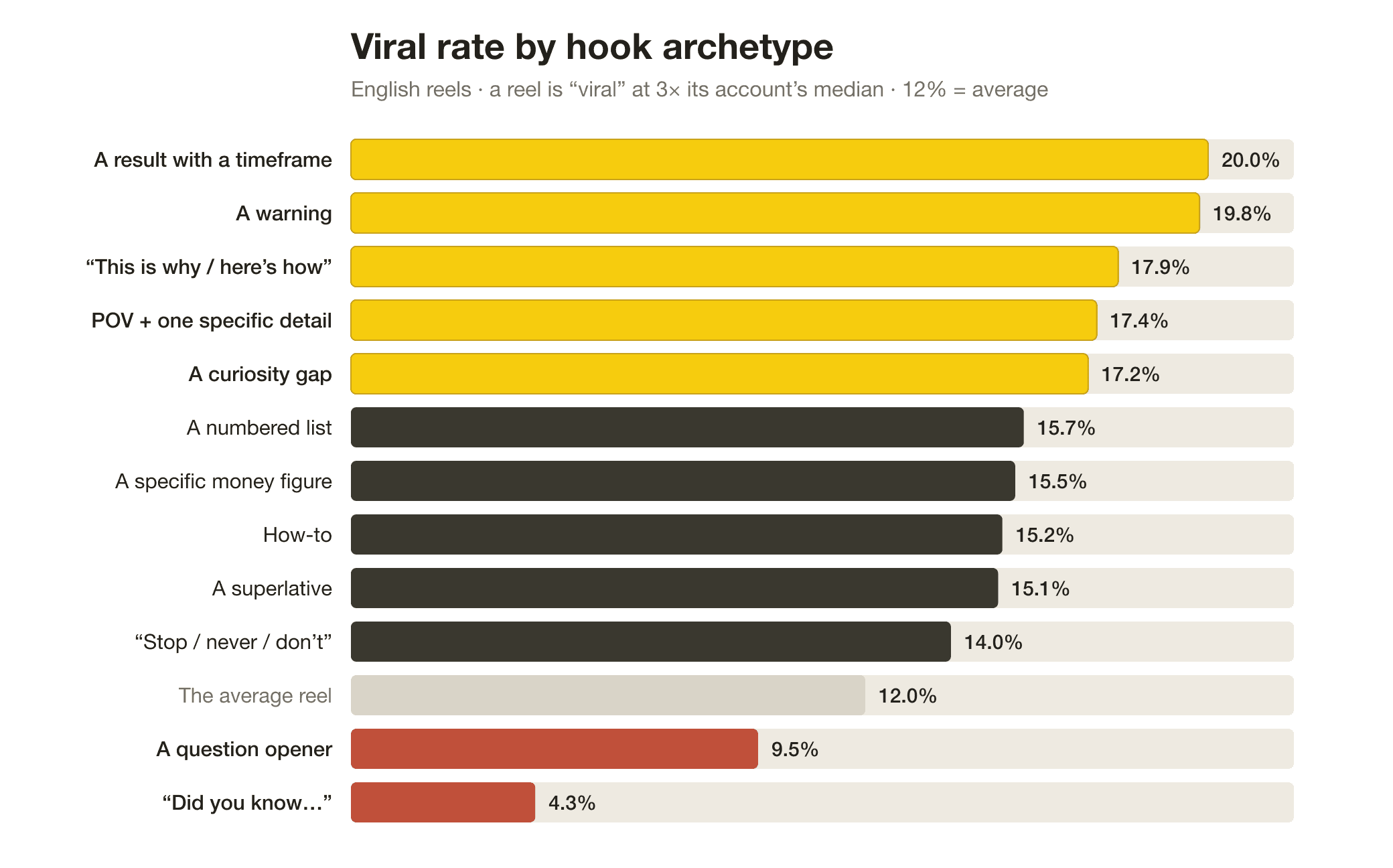
Assertive openers cluster at the top; "did you know" sits at the bottom, a third of the average.
The super-viral openers make it concrete. "POV: you're a mom and your kids say 'watch this mom' 8,450 times a day." "I watched a top performer's career vanish in a two-sentence Teams message." "Never pay mortgage insurance, even if you're only putting 5% down." Specific, immediate, mid-scene. Not one reel in our super-viral list opens with a greeting, a warm-up, or a generic question.
On-screen text: frame one or never
Reels whose first text overlay appears at the very first frame went viral at 18.3% in the subset where we track overlay timing. Delay that overlay by even half a second and the rate drops to 9–13%.
The reason is mechanical. Most impressions die in the first swipe-moment, before a delayed overlay ever renders. Text that isn't on frame one may as well not exist.
Two related findings. Openings that combine a spoken line, on-screen text, and a visual moment outperformed visual-only openings 20.8% to 14.9% — the modalities stack. But piling on more hook elements doesn't: reels with four or more hooks in the first seconds performed no better than reels with one sharp one. Add a text hook to your spoken hook. Then stop.
Story beats showcase — by 2×
Every reel got a structure label. The spread is wide, and it isn't the ranking most creators post by:
- Story — 15.7% viral
- Raw, unedited footage — 13.3%
- Tutorial — 12.1%
- Talking head — 9.3%
- Montage — 8.0%
- Showcase (polished product/result footage) — 7.8%
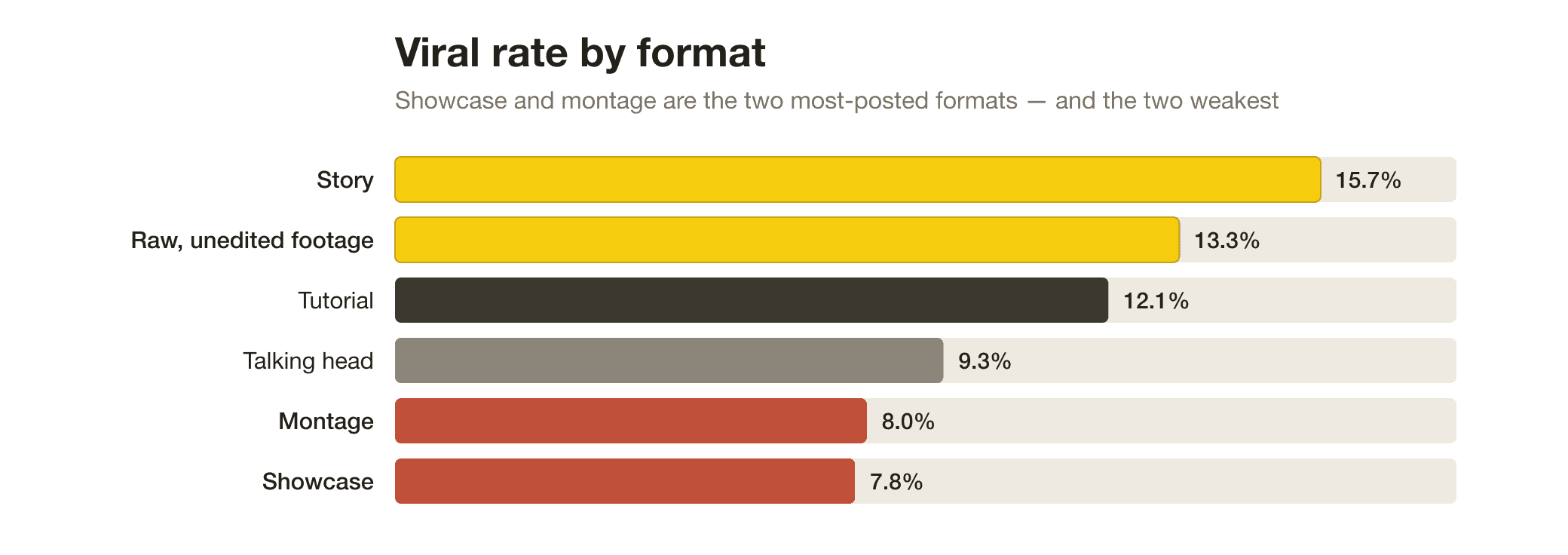
Story and raw footage lead; the two most-posted formats — montage and showcase — trail.
This holds inside individual accounts: story reels beat the same creator's showcase reels in 60% of accounts that posted both, and raw footage beat showcase in 63%. It also replicated across English, Spanish, Portuguese, and Turkish content.
Here's the uncomfortable part. Showcase and montage — the two weakest formats — are also the two most posted, at 29% and 12% of the whole sample. The market is oversupplied with polish and undersupplied with narrative. If your reels are beautiful and going nowhere, this is probably why: wrap the showcase in a story ("the client asked for X, so we tried…") and it becomes the strongest format instead of the weakest.
The 20–45 second dead zone
Length follows a U-curve, not a rule of thumb:
- 7–12 seconds — 11.7% viral. Short enough to loop; median watch-through there is 68%, and under 7 seconds it's near 99% because viewers rewatch.
- 60–90 seconds — 10.9%. Long enough for a story that earns total watch time.
- 20–45 seconds — 8.6–9.0%. The dead zone. Too long to loop, too short to tell a story.
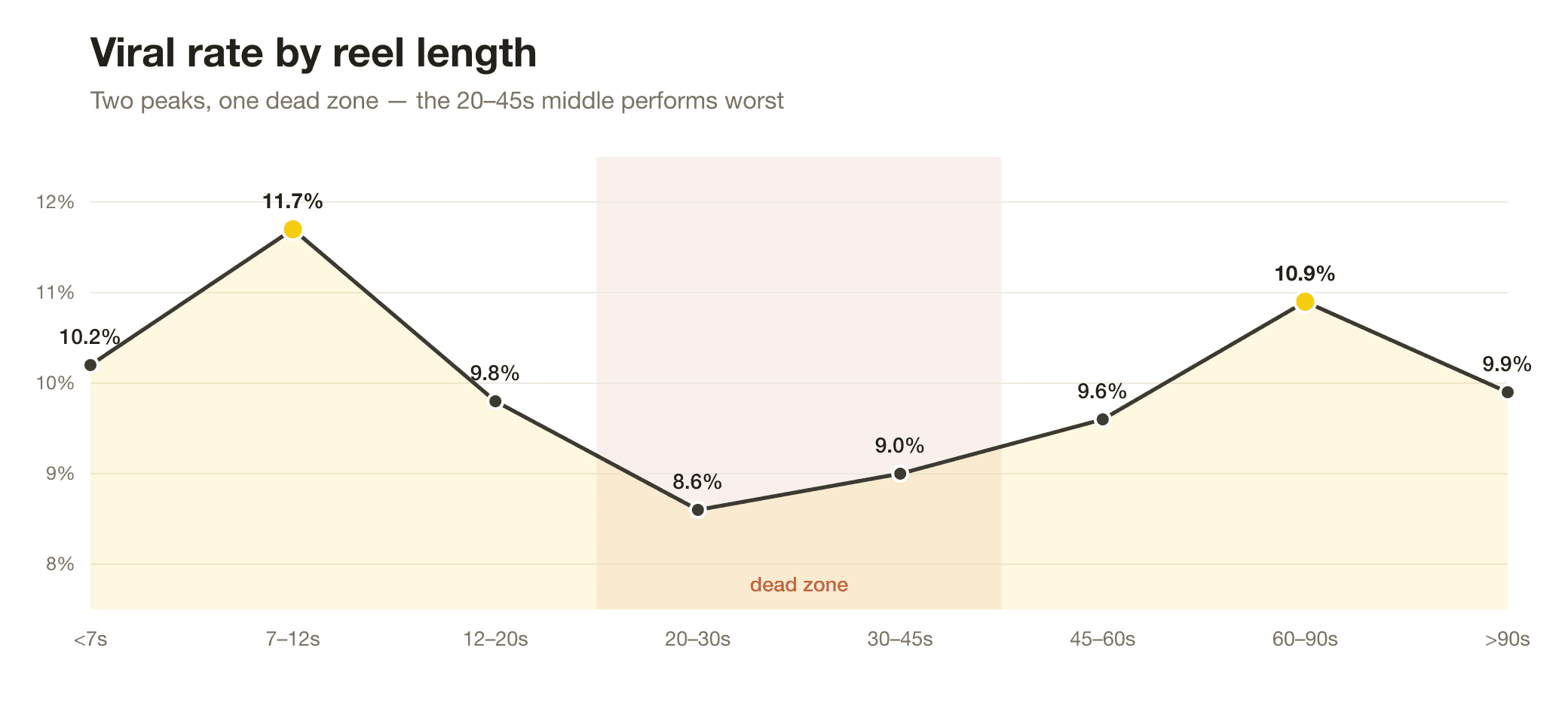
The length curve is a U: short-and-loopable or long-and-narrative win; the 20–45s middle is the dead zone.
Within accounts, reels of 12 seconds or less beat the same creator's longer reels 59% of the time. Pick a side of the curve deliberately: loopable and short, or narrative and long. Defaulting into the middle is the one length decision the data clearly punishes.
What didn't matter
Original research is only trustworthy if it reports the nulls too. Three popular tactics did nothing in our data:
Repeating your spoken hook as on-screen text. We token-matched overlays against opening lines on 4,630 reels. Mirrored text performed no better — within accounts it was a coin flip. The overlay should add a second hook, not caption the first one.
Ending with a call to action. Reels with a CTA went viral slightly less often (15.9% vs 17.9% in the subset tracking it). CTAs did lift shares and saves by roughly 45%, so keep them when you want an action — just don't expect the algorithm to reward the ask itself.
The ingredient list. Captions on or off, music or none, voiceover or not — none of it moved virality within accounts. What the first overlay says, and when it appears, matters. Whether your reel "has overlays" doesn't.
How to make your next reel go viral
The findings compress into a short checklist: open with an assertion instead of a question, put a different text hook on frame one, tell a story or show raw footage instead of a polished montage, and commit to under 12 seconds or over 60.
The harder problem is that you don't know which hook or which length works for your audience until you've tested it — and testing on your main feed means your followers absorb every miss. That's the exact problem Instagram Trial Reels exist to solve: they go to non-followers first, so an experiment that misses never touches your feed. If you're unsure when a Trial Reel beats a regular post, we wrote a decision guide on that too.
Buzzfy automates the loop this study describes: it takes your best-performing reels, creates variants — different hooks, different pacing, different subtitles — and posts them as Trial Reels to new audiences every day, so the testing happens while you make the next thing. The same analysis engine that produced this dataset scores every reel along the way. If you want to see what it would do with your account, show me my growth plan takes about two minutes.
How we ran the numbers
Sample: 26,914 organic reels with view data, from 944 creator accounts with at least five analyzed reels each — mostly micro and mid-tier creators, not celebrities. Each reel's content analysis (transcript, hook, structure, overlays, pacing) was produced by AI without access to performance data, then joined with the reel's Instagram insights. "Viral" = at least 3× the account's own median views.
Two honest caveats. The findings are correlational; the within-account paired comparisons remove account-level factors like follower count and niche, but they don't prove causation. And the hook-archetype analysis covers English-language reels, with some archetypes measured on small samples — treat the exact percentages as directional and the ordering as solid.
FAQ
What counts as going viral on Instagram?
There's no official threshold. The honest definition is relative: a reel that significantly outperforms your account's normal reach — we used at least 3× your median views, which captures roughly the top 10% of reels. A 15,000-view reel on a 2,000-follower account is viral; the same number on a 500,000-follower account is a quiet Tuesday.
How long should a reel be to go viral?
In our 26,914-reel dataset, two lengths outperformed: 7–12 seconds (loopable, near-perfect watch-through) and 60–90 seconds (story-driven, high total watch time). The 20–45 second middle performed worst — too long to loop, too short for a story.
What is the best hook for a reel?
Assertive openers won in our data: a result with a timeframe, a warning, "this is why…", or a POV line with one hyper-specific detail — all 17–20% viral rates against a 12% base. Question openers underperformed, and "did you know" was the worst opener we measured at 4.3%.
Do CTAs help a reel go viral?
Not directly. Reels with a call to action went viral slightly less often in our data, but CTAs lifted shares and saves by about 45%. Use one when you want a specific action; skip it when pure reach is the goal.